THE KEY DECISIONS
The essentials at a glance.
- Match the supply requirement to the exact strip.
- Calculate each connected circuit, not only the order total.
- Review driver loading, controls and power-feed limits separately.
What does 24V DC mean?
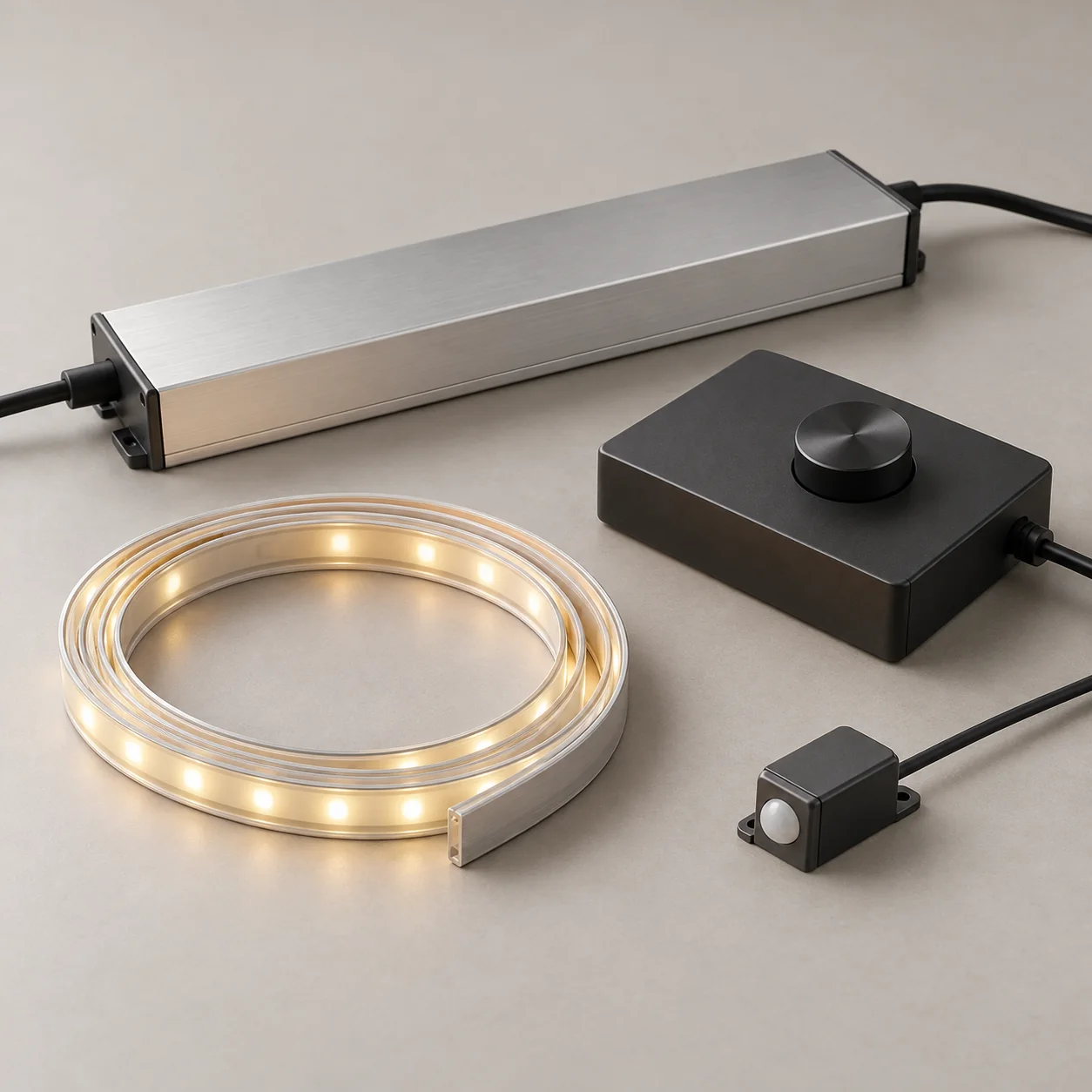
A 24V DC LED strip is designed for the specified low-voltage DC supply. It is not connected directly to mains electricity. Verify that the selected product requires a constant-voltage driver and check the manufacturer’s installation instructions. A mains-side connection should be handled by a qualified installer under local electrical requirements.
How do you calculate the connected load?
Multiply the confirmed power per metre by the length connected to that driver: connected load (W) = strip power (W/m) × length (m). For illustration only, a hypothetical 10 W/m strip installed over 8 m has an 80 W nominal connected load. This example is not a BEXLIGHTING product rating. Select capacity using the driver manufacturer’s loading, temperature and derating requirements; do not treat a generic percentage as a universal rule.
Why can brightness fall along a long run?
Conductors have resistance. Cable length, cross-section, current and the strip’s copper layout affect voltage at the load. A visible difference in output along the strip can result when the voltage changes enough to affect operation. Supply voltage, cable sizing and power-feed arrangement must be reviewed together. Do not infer a safe or uniform run length from LED density alone.
What should the wiring plan include?
Provide the individual illuminated lengths, distance to the driver, available cable routes and driver locations. Ask for the permitted feed arrangement and maximum run for the exact SKU. Several shorter runs can require a different circuit layout from one continuous length, even when the total metres are identical.
How do controls change the specification?
Dimming compatibility depends on the complete system: strip, driver, controller and control protocol. A driver described as dimmable is not automatically compatible with every dimmer. Tunable white also needs an appropriate channel arrangement. State the intended controls at the quotation stage and ask for compatibility documentation.
A PRACTICAL REFERENCE
Keep the key product details together.
| Record | Why it matters | Where to confirm |
|---|---|---|
| W/m and connected length | Determine nominal connected load | Exact datasheet and circuit schedule |
| Supply voltage and type | Match the strip and driver | Component installation documents |
| Cable route and feed position | Review voltage at the load | Project wiring review |
| Controls and loading conditions | Check system operation and derating | Driver and controller instructions |
Take the next step.
- List each powered section and its length.
- Record confirmed W/m and the proposed supply voltage.
- Add cable distances, driver access and the intended controls.
- Request the exact permitted run and feed layout.
Questions and answers
Can a 24V strip use a 12V supply?
Use the voltage specified for the strip. A mismatched supply is not an approved substitute and may give incorrect operation or damage equipment.
What is the maximum continuous run?
There is no single run length that applies to every 24V strip. Use the manufacturer’s limit for the exact SKU and the proposed feed arrangement.
Does a larger driver fix voltage drop?
Driver capacity and voltage drop are different issues. More rated watts do not automatically correct undersized cables or an unsuitable feed layout.
Talk to BEXLIGHTING about your project.
Return to the resource library →
Explore the current product catalogue →
Review exact product requirements before preparing an inquiry.