KEY TAKEAWAYS
Key points from this article
- Write the desired switching sequence before choosing a sensor.
- Confirm ratings and the strip–sensor–controller–supply arrangement.
- Test the actual door and keep electrical parts accessible.
Write down the switching behaviour
Should one door activate one compartment, or should any open door switch the entire wardrobe? Should the light operate manually, by door sensing or by movement? Describe the sequence clearly before selecting components.
Separate the user behaviour from the component choice. Describe which doors or compartments activate which light sections, whether manual operation is needed and what should happen after a door closes. BEXLIGHTING can then discuss the control setup with you.
Check the complete control chain
Identify the strip, supply voltage, driver, sensor and any controller. Confirm the permitted wiring arrangement and rated load. Shared voltage alone does not prove that components can be connected together or that a sensor supports the proposed current.
Ask for the permitted connection arrangement for the selected components. Record the sensor and controller references alongside the strip SKU. A shared nominal voltage does not confirm signal type, switching capacity or interoperability.
Concept diagram only. Not to scale; connections, supply and feed limits require the exact component instructions.
Review the mounting position
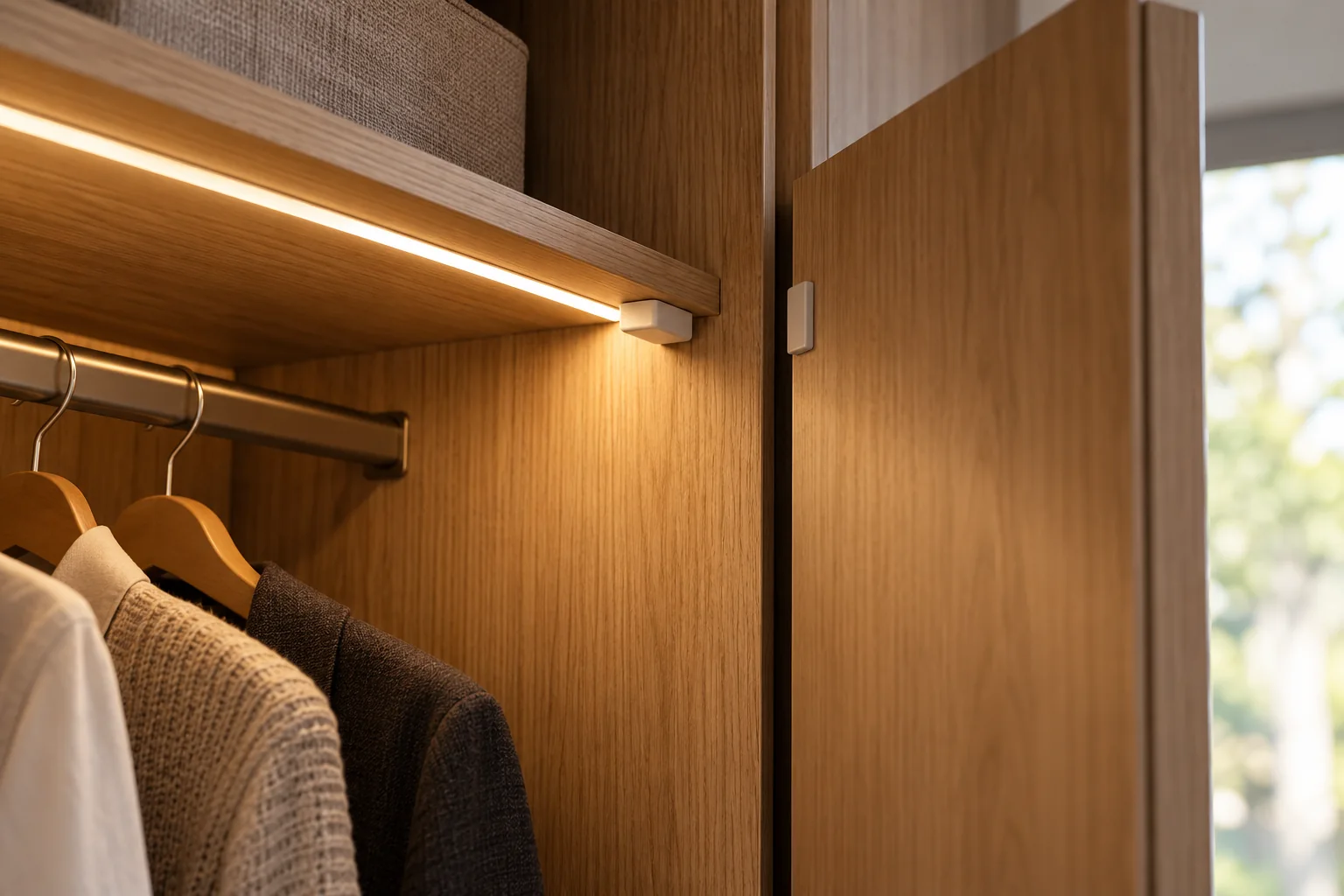
Door construction, shelf layout and nearby movement can affect sensor placement. Use the manufacturer’s instructions for the selected device and test operation on a representative furniture module. Do not assume a generic sensor location will work for every door.
Use the real door construction and representative compartment contents when testing. Review the sensor position, obstructions, door movement and the effect of adjacent compartments. Keep the approved position on the furniture drawing.
Keep service access in the furniture detail
Drivers and connections may need inspection or replacement. Show access locations on the furniture drawing and plan how components can be reached after installation. Keep the approved wiring diagram and component references with the order.
Define how a sensor, connector or supply can be inspected and replaced after the wardrobe is fitted. Service access belongs in the cabinet detail; it should not be left until the furniture is closed.
A PRACTICAL COMPARISON
Compare the decisions side by side.
| Operation to define | System question | Approval method |
|---|---|---|
| One door / one compartment | Which light section follows that door? | Test the representative module. |
| Multiple doors | Does any open door activate all sections? | Record the required switching sequence. |
| Adjustable white | How does sensing interact with the controller? | Review the complete control arrangement. |
| Maintenance | How can components be reached after fitting? | Show access on the furniture drawing. |
PLANNING EXAMPLE
Describe the sequence in plain language.
Planning example: the left door activates the left compartment, the right door activates the right compartment, and each section follows its own door. This describes the required behaviour; it is not a wiring diagram or confirmation that a particular sensor supports it.
YOUR NEXT STEP
Helpful details for your project.
- A written door and light switching sequence
- Exact strip, sensor, controller and supply references
- Rated load and approved connection instructions
- A tested furniture module with documented service access
Questions about this topic.
Does a wardrobe have to use a door sensor?
No. Choose the operating behaviour around the furniture and user requirements, then review suitable components.
Is a 24V label enough to match the sensor and strip?
No. Check ratings, permitted connections and the complete control system.
Should sensors be specified before furniture manufacture?
Yes, their position, mounting space, wiring and service access should be coordinated with the furniture detail.
Apply the reading to your project.

Wardrobes & closets
Integrate discreet light into hanging compartments, drawers and shelves. Review visibility, sensor behaviour, access and the fit of the complete assembly.
Explore the solution →Comparison candidates only. Confirm the exact product and complete assembly for the application.
Discuss this application